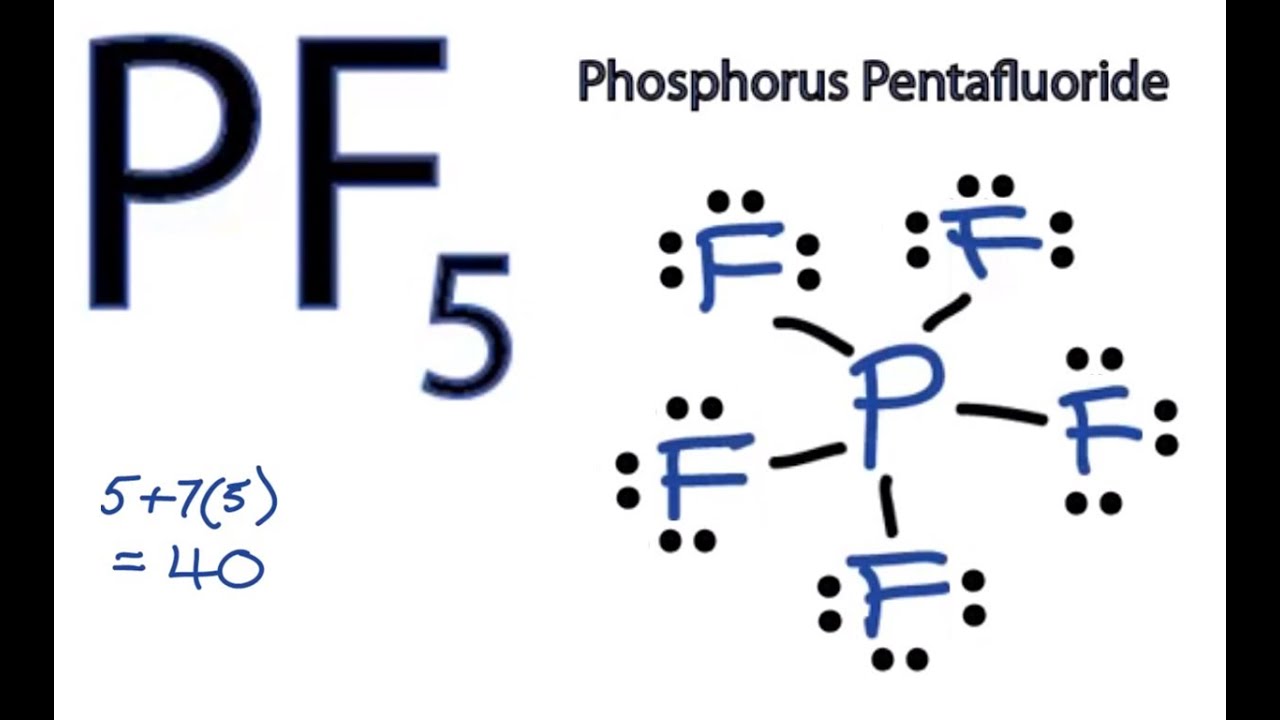
Molecular Geometry Of Pf5. Pf5 has symmetric charge distribution of fluorine atoms around the central atom phosphorous. Askedaug 5, 2019in chemistryby jomoo1628.
PF5 Lewis Structure How to Draw the Lewis Structure for from www.youtube.com
The central atom, nitrogen has four electron pairs; Pf5 (phosphorus pentafluoride) has five fluorine atoms surrounding a central phosphorus atom. A model of hcl molecule must be constructed by using ball with 1 stick.
Pf5 Has Symmetric Charge Distribution Of Fluorine Atoms Around The Central Atom Phosphorous.
It has vsepr notation of ax5, which is a trigonal bipyramidal s. The phosphorus pentafluoride pf5 is a nonpolar molecule because the configuration of pf5 has trigonal bipyramidal and pf5 consists of a central phosphorus atom surrounded by five fluorine atoms. The molecular geometry of pf5, phosphorus pentafluoride , is triangular bipyramidal.
Eg = Tetrahedral, Mg = Trigonal Bipyramidal.
59) draw the molecular orbital diagram shown to determine which of the following is paramagnetic. The molecular geometry of phosphorus pentafluoride (pf5) is triangular bipyramidal. The electron pair arrangement of is tetrahedral.
Phosphorus Forms Single Bonds With All Five Fluorine Atoms, Which.
Determine the electron geometry (eg) and molecular geometry (mg) of pf5. The resulting shape is a trigonal bipyramidal in which three fluorine atoms occupy equatorial and. Phosphorus pentafluoride has 5 regions of electron density around the central phosphorus atom (5 bonds, no lone pairs).
It Is A Chemical Formula Of Phosphorous Pentaflouride.
The parent hydride compound is the hypothetical molecule ph5. The molecular geometry of this molecule is trigonal bipyramidal, which means two atoms of fluorine are located in an axial position, and the other three are in the equatorial position. What is the electron geometry of pf5?
It Has The General Formula Pr5.
Therefore, the molecular geometry of should be. The lewis structure for bromine pentafluoride is square pyramidal. All the four electron pairs are bonding with no lone pair of electron.