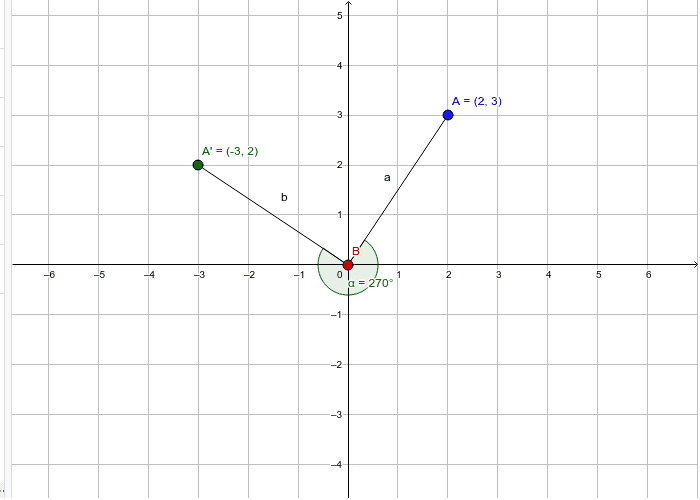
Rotating 270 Degrees Counterclockwise. Rotating 270 degrees clockwise about the orign. Conventionally, shapes are rotated counterclockwise on a coordinate plane.
Rotating 270 degrees clockwise about the orign GeoGebra from www.geogebra.org
One such rotation is to rotate a triangle 270 ° counterclockwise , and we have a special rule that we can use to do this that is based on the fact that a 270 ° counterclockwise rotation is the same thing as a 90 ° clockwise rotation. 👉 learn how to rotate a figure and different points about a fixed point. Read this page to find out what a 270 degree counterclockwise rotation means on a circle (or clock).
What Will Be The Coordinates Of Point N After A 270 Counterclockwise Rotation About The Origin?
Since the rotation is 90 degrees, you will rotating the point in a clockwise direction. Rotating a shape 270 degrees is the same as rotating it 90 degrees clockwise. We will start by displaying the 270 degree counterclockwise rotation illustration and then explain its parts.
👉 Learn How To Rotate A Figure And Different Points About A Fixed Point.
Rotating a shape 270 degrees is the same as rotating it 90 degrees clockwise. 270 degree rotation means that we want to travel 270 degrees of those 360 degrees. Click and drag the blue dot to see it's image after a 270 degree clockwise rotation about the origin (the green dot).
Is A 90 Degree Rotation Clockwise Or Counterclockwise?
One such rotation is to rotate a triangle 270° counterclockwise, and we have a special rule that we can use to do this that is based on the fact that a 270° counterclockwise rotation is the same thing as a 90° clockwise rotation. There are two different directions of rotations, clockwise and. There are two different directions of rotations, clockwise and counterclockwise:
What Is The Rule For Rotating 270 Degrees Counterclockwise?
Since, 270 degree clockwise rotation = 90 degree counterclockwise rotation, both the movements will result in same final coordinate. Rotating a shape 270 degrees is the same as rotating it 90 degrees clockwise. This means, we switch x and y and make x negative.
Note That A Geometry Rotation Does Not Result In A Change Or Size And Is Not The Same As A Reflection!
The azimut is the angle formed between a reference direction (in this example to the north) and a line from the observer at a point of interest projected on the same level as the direction of reference orthogonal to zenit. 360 degrees doesn’t change since it is a full rotation or a full circle. You should assume this, unless it is noted in the problem that you need to rotate clockwise.