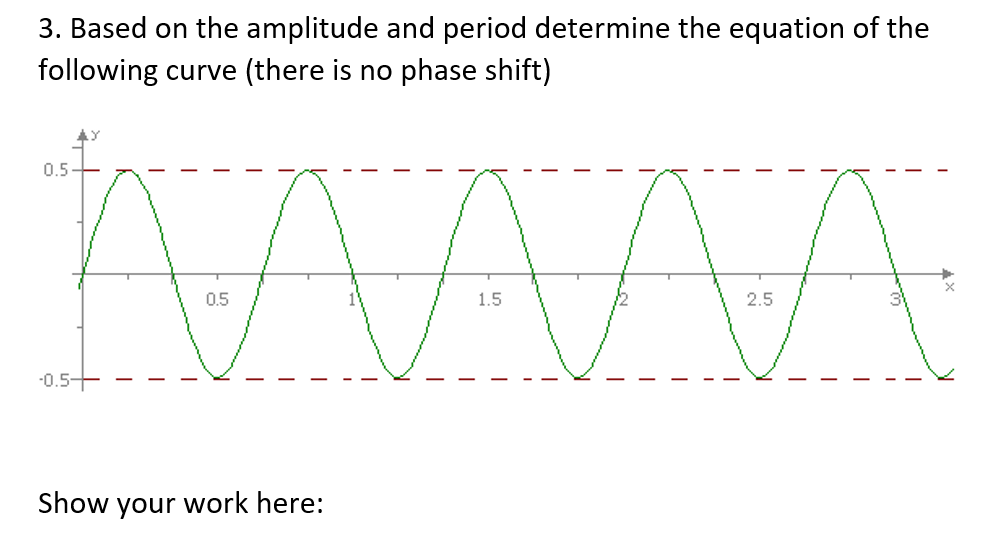
Amplitude Period Phase Shift Equation. 👉 learn how to graph a sine function. On comparing the given equation with phase shift formula we get amplitude, a = 3 period, 2π/b = 2π/4 = π/2 vertical shift, d = 2 so, the phase shift will be −0.5 which is a 0.5 shift to the right.
Solved 3. Based On The Amplitude And Period Determine The from www.chegg.com
C = 0 c = 0. Amplitude, period, phase shift and frequency. The number c is called the phase shift.
Then Write An Equation Of Each Graph.
The period goes from one peak to the next (or from any point to the next matching point):. The phase shift of the given sine function is 0.5 to the right. State the amplitude, period, phase shift, and vertical shift for each function.
Y = Tan ( + ± 2 62/87,21 Given A = 1, B = 1, H = ± And K = ±2.
Time period is defined as time considered one complete cycle of resonance to pass provided factor. The phase shift equation is ps = 360 * td / p, where ps is the phase shift in degrees, td is the time difference between waves and p is the wave period. This is the phase shift or the horizontal shift.
Together, These Properties Account For A Wide Range Of Phenomena Such As Loudness, Color, Pitch, Diffraction, And Interference.
One period = 3 π/ 2. C = 0 c = 0. Then graph using the midline as reference.
Where Is Amplitude, Period Is And The Phase Shift Is Equal To Set To Zero.
The number c is called the phase shift. What is the general equation of a sine function with an amplitude? We reproduce the graph of 1.a below and note the following:
Therefore The Period Of This Function Is Equal To 2 /6 Or /3.
To find amplitude, look at the coefficient in front of the sine function. 2 /b y = a sin bx starting point: The period moves from one point to the next matching point—the peak of the function—the period of a.